Harald Feller, a Diplomat with an Extraordinary Fate
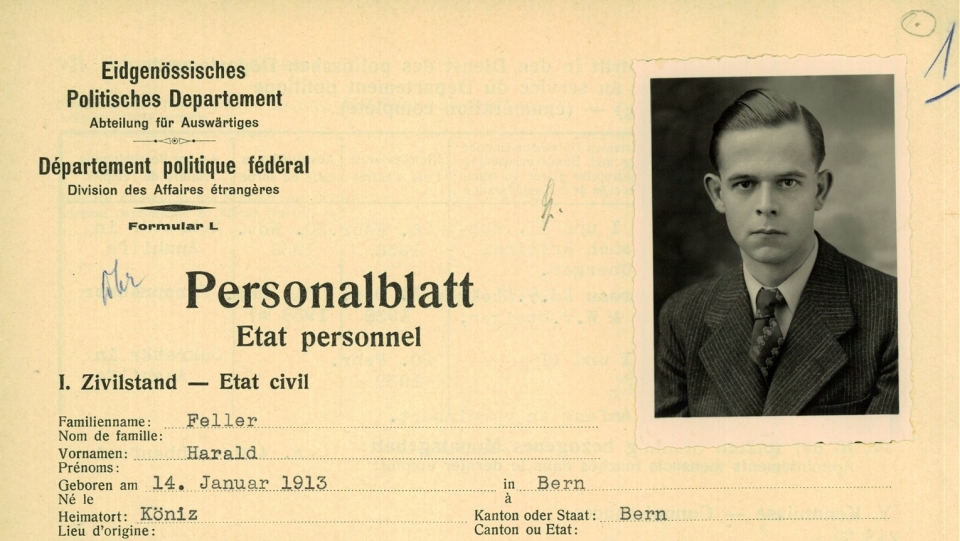
Posted in Budapest since 1943, Harald Feller rescued Jewish women and men, as well as Swedish diplomats before being abducted by agents of the Soviet secret service during the liberation of the Hungarian capital in February 1945. He then languished for a year in Stalin’s Moscow prisons, together with his colleague Max Meier, who had also been abducted in Budapest shortly before him. The two Swiss men, along with other compatriots held in northern Poland and in the Far East, were able to return to Switzerland in 1946 after lengthy negotiations conducted in Bern with a Soviet military delegation. During his absence, Feller was the subject of serious accusations by former colleagues and in the press. Federal Councillor Max Petitpierre also ordered an investigation, which was entrusted to Judge Jakob Kehrli. This investigation fully exonerated him. Harald Feller left the diplomatic service in 1949, ten years after having entered it.
The Protection and Rescue of Jewish Women and Men in Budapest
While his colleague Carl Lutz at the legation in Budapest, headed by Minister Maximilian Jaeger, was responsible for protecting Jewish women and men who were nationals of states whose interests Switzerland represented, in particular those destined to immigrate to Palestine under British mandate, Harald Feller was entrusted with the protection of Swiss Jews and of those who had ties with Switzerland. He organised the repatriation of Swiss and Liechtenstein Jewish women and men during the summer of 1944, as he describes in a synthesis report (dodis.ch/77372). He also endeavoured to repatriate Swiss women of Jewish faith who had lost their citizenship following their marriage to Hungarian men. The Federal Department of Justice and Police refused to issue them individual passports (dodis.ch/77373) and to draw up a collective passport to protect them (dodis.ch/77374, dodis.ch/77375). Several of them were nevertheless able to return to Switzerland thanks to identity certificates. Feller also hid Jewish people in his home. In the chancery of the legation, he offered asylum to Swedish diplomats who had been attacked by pro-Nazi Hungarians, the Arrow Cross. He himself was kidnapped by the Arrow Cross, severely mistreated, and owed his survival only to a threat he had entirely invented (dodis.ch/77426, pp. 113–128). A list of the people saved by Feller was drawn up in 1946 (dodis.ch/77415).
Swiss Women and Men Abducted or Detained by Soviet Agents
In February 1945, Harald Feller, then head of the Swiss legation, and his colleague Max Meier were abducted in Budapest by agents of the Soviet secret services before being taken to Moscow. Feller would later describe his months of captivity in Lefortovo prison in a long report (dodis.ch/77380). In Elbing, in northern Poland, Carl Brandenberg, two other consular agents and about a dozen members of the Swiss colony were forcibly detained on the arrival of Soviet military troops at the beginning of 1945. In September of that same year, Boris Bryner, who was in charge of the consular agency in Dairen, and his family were forcibly taken to the USSR, near Vladivostok. Brandenberg and Bryner also wrote reports on these events (dodis.ch/77378, dodis.ch/77381).
Negotiations in Switzerland and an Exchange
In July 1945, a military delegation headed by Major General Vikharev arrived in Switzerland to look into the situation of Soviet military internees and organise their repatriation. The delegation exerted considerable pressure on Switzerland to send all internees back to the USSR, while Switzerland strongly wished to re-establish diplomatic relations, which had been broken off in 1918 (dodis.ch/W30539). The negotiations then moved towards an exchange. On the Swiss side, the liberation of Feller and Meier was demanded (dodis.ch/77376), as was the return of Brandenberg, his colleagues and Bryner’s family. On the Soviet side, Vikharev demanded the handover of a handful of internees imprisoned for offences, as well as an engineer and a military pilot who refused to return to the USSR. The Federal Council adopted a firm position (dodis.ch/77377). The Soviets then proposed linking the two sets of demands. On 28 December 1945, the Federal Council found itself facing an ultimatum (dodis.ch/53). It accepted the Soviet demands without being certain that the Swiss prisoners would return (dodis.ch/1340).
Accusations and Investigations
Feller’s and Meier’s former colleagues were expelled from Budapest and returned to Switzerland in May 1945. Several of them wrote activity reports, including Carl Lutz, who made a series of accusations against Feller (dodis.ch/77420). Federal Councillor Max Petitpierre asked Jakob Kehrli, a judge at the Supreme Court of the Canton of Bern, to determine the circumstances and reasons for the abductions of Feller and Meier. Kehrli interviewed all of the personnel who had been posted in Budapest. He submitted a report at the end of July 1945 (dodis.ch/18858). This report was not published, in particular because of the negotiations that were currently underway. After Feller and Meier returned, Lutz requested that a press release be published on all the activities of the Swiss legation in Budapest (dodis.ch/77379). The Federal Political Department did not agree to this, because it had ordered the questioning of Feller and a new investigation. The 21 hearings that Feller participated in (dodis.ch/77426) made it possible to better understand the dramatic period during which he found himself at the head of the Swiss legation in Budapest, namely the siege and liberation of the city by the Red Army after fighting that caused nearly 160,000 civilian and military casualties. Kehrli concluded his investigations on 24 June 1946 (dodis.ch/78050). A summary of his findings was prepared in 1948 (dodis.ch/77382). Feller was exonerated, but left diplomatic service the following year.